Concrete Calculator
Calculate concrete volume, weight and cost for any slab, footing or wall. Supports cubic yards, bags and ready-mix. Enter dimensions, select units and add waste to get instant, supplier-ready numbers.
Enter dimensions above to calculate
- Enter values to see step-by-step substitution.
Engineering Assumptions:
- Rectangular sections of uniform thickness. Split irregular shapes into non-overlapping rectangles.
- Thickness and reinforcement must come from project plans; volume alone does not establish load capacity.
Advertisement — after results
Reserved for AdSense — no layout shift.
4K VISUAL GUIDE — PHOTOREALISTIC PREMIUM
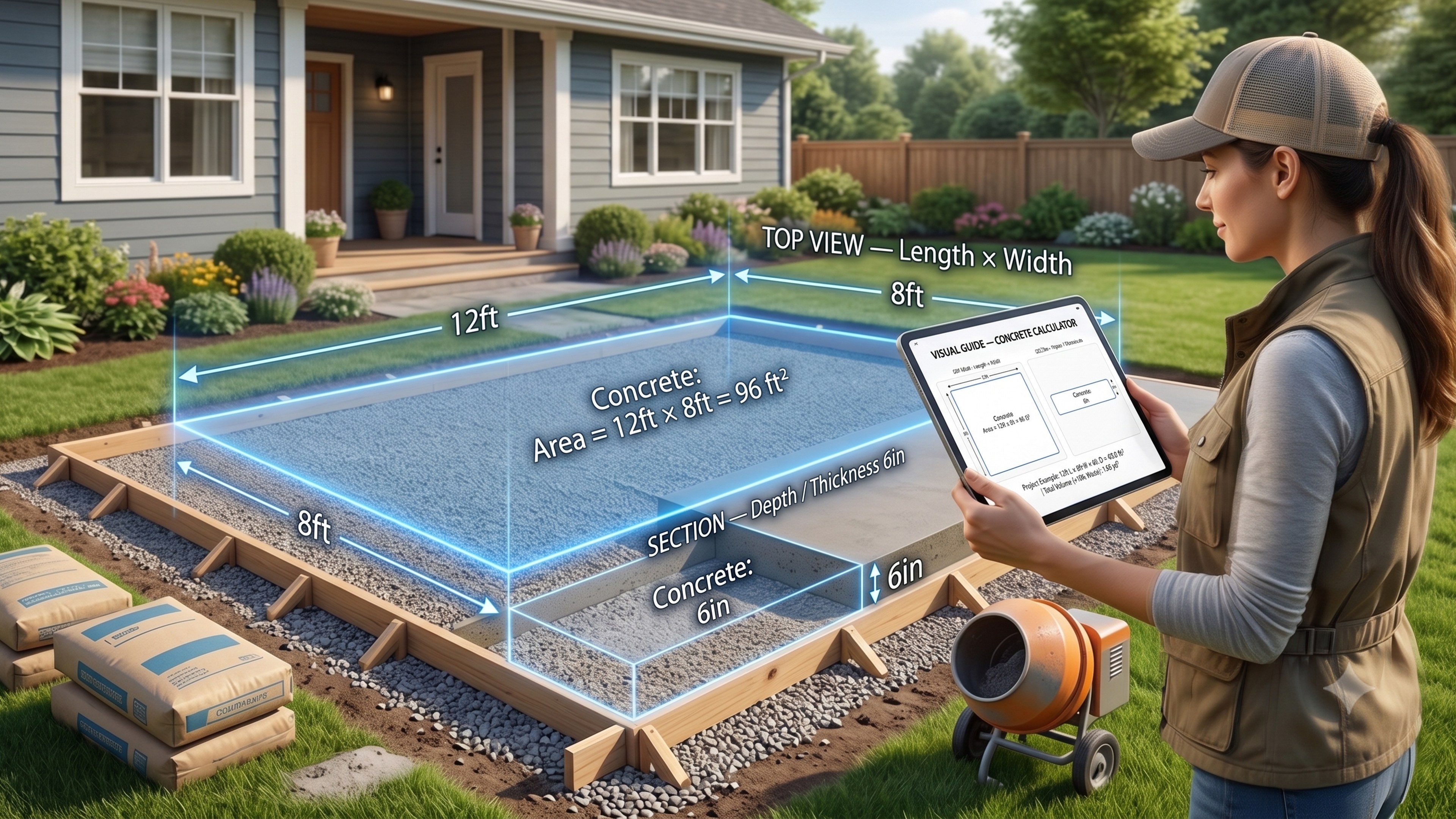
Photorealistic 4K — Your requested 2(3).png upscaled to 3840×2160 — Length 12ft × Width 8ft =96 ft² @6in • Section 6in
HOW IT WORKS — 3 SIMPLE STEPS (ORIGINAL 4K)
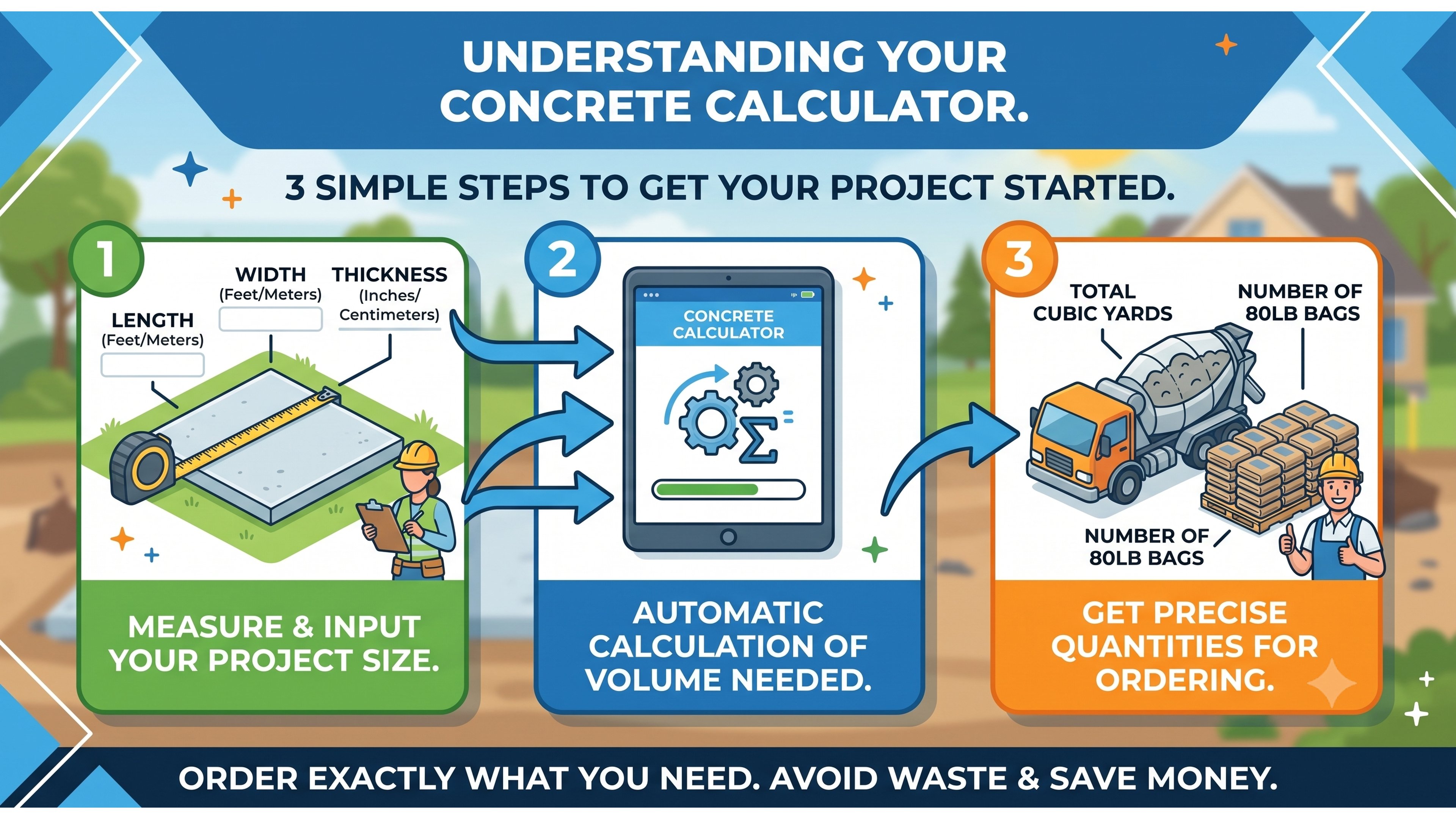
Your original — Measure → Automatic Volume → Order Bags/Truck — 4K upscaled, 846KB JPEG
What Is This Calculator?
The Concrete Calculator — Estimates concrete volume, weight and ready-mix versus bag count for US slabs, footings and walls.
What Does It Calculate?
- Concrete volume in cubic yards and cubic feet
- Ready-mix loads vs 40/60/80-lb bags
- Weight and cost with waste
How to Use the Calculator
- Measure Concrete 20 ft x 10 ft x 4 in — use feet for length/width and inches for thickness where typical.
- Enter values and select units. The calculator converts to feet before calculating (inches /12, yards x3).
- Adjust waste % and optional price, then click Calculate. Results show with waste included.
- Use Reset to clear and try another size.
Formula & Engineering Methodology
V = length × width × thickness × identical sections
- L — Length for Concrete in feet
- W — Width for Concrete in feet
- D — Depth for Concrete in feet
All units convert to exact standard engineering dimensions (NIST SP 811) before calculation to ensure consistency between US Customary and Metric measurements.
Worked Example
Example: Concrete 20 ft x 10 ft x 4 in
| STEP | VALUE |
|---|---|
| Convert depth | 4 in /12 = 0.333 ft |
| Cubic feet | 20 x 10 x 0.333 = 66.67 ft3 |
| Cubic yards | 66.67 /27 = 2.47 yd3 |
| With 10% waste | 2.72 yd3 |
Construction Information
Material: Concrete — 4000 psi typical for driveways, 3000 psi for patios. Ordered by cubic yard (27 ft³) or bags (0.60 ft³ per 80-lb). Keep slump 4 in for slabs.
- Measure longest x widest; split L-shapes into two rectangles and add.
- Compact subgrade — soft spots add thickness.
- For structural sizing (beams, headers, rebar) verify with a professional per local code.
Material Information
Concrete — 4000 psi typical for driveways, 3000 psi for patios. Ordered by cubic yard (27 ft³) or bags (0.60 ft³ per 80-lb). Keep slump 4 in for slabs.
Waste & Overages
Add 5–10% for spillage and uneven subgrade — 10% is safe for hand-screeded forms.
Practical Tips
- Order ready-mix over ~1 yd³ (45 bags) — faster and cheaper
- Keep subgrade compacted and forms braced
- Add one extra bag per 10 as buffer
Common Mistakes
- Forgetting to convert inches to feet (4 in = 0.333 ft)
- Ordering the theoretical minimum — second trip costs more than 10% waste
Assumptions & Engineering References
- Rectangular sections of uniform thickness. Split irregular shapes into non-overlapping rectangles.
- Thickness and reinforcement must come from project plans; volume alone does not establish load capacity.
This calculator provides an estimate based on your inputs. Actual requirements vary by site, material and installation. For code-regulated or load-bearing work, consult a qualified professional.
Calculations run 100% in your browser — zero tracking of your dimensions or input data.
Related calculators
Concrete Volume Calculator
Calculate concrete volume in cubic yards and cubic feet for ...
Concrete Cost Calculator
Estimate concrete cost per cubic yard and per bag — compare ...
Concrete Pour Calculator
Calculate concrete pour volume, bags and weight — cubic yard...
Concrete Mix Calculator
Calculate concrete mix — cement, sand, aggregate and bags fr...
Concrete Weight Calculator
Calculate concrete weight in pounds, short tons and metric t...
Concrete Slab Calculator
Calculate concrete slab volume, bags and weight — cubic yard...
Frequently asked questions
What does the Concrete Calculator calculate?
The Concrete Calculator estimates concrete quantity for US jobs — Concrete volume in cubic yards and cubic feet, Ready-mix loads vs 40/60/80-lb bags, Weight and cost with waste. Enter dimensions, choose units, add waste and price to get instant results.
How do I measure for concrete?
Measure concrete 20 ft x 10 ft x 4 in on site. Use the unit selectors — the tool converts inches→feet (÷12) and yards→feet (×3) before math. For non-rectangular, split into rectangles and add.
How much waste should I add?
Add 5–10% for spillage and uneven subgrade — 10% is safe for hand-screeded forms.
How accurate is this concrete estimate?
Math is exact for your inputs. Actual needs vary by site, material and installation. Add 5–10% waste for rectangular, 10–15% for irregular.
About Calculator Street
Built by Vipul Otari for US homeowners & contractors. Calculator inputs are processed in your browser. Estimates depend on your measurements, product specifications and the assumptions shown on this page. Confirm order quantities with your supplier and structural requirements with your project designer. Page updated: 2026-09-11.